10 Cozy Fall Bedroom Ideas for a Moody, Warm Seasonal Reset
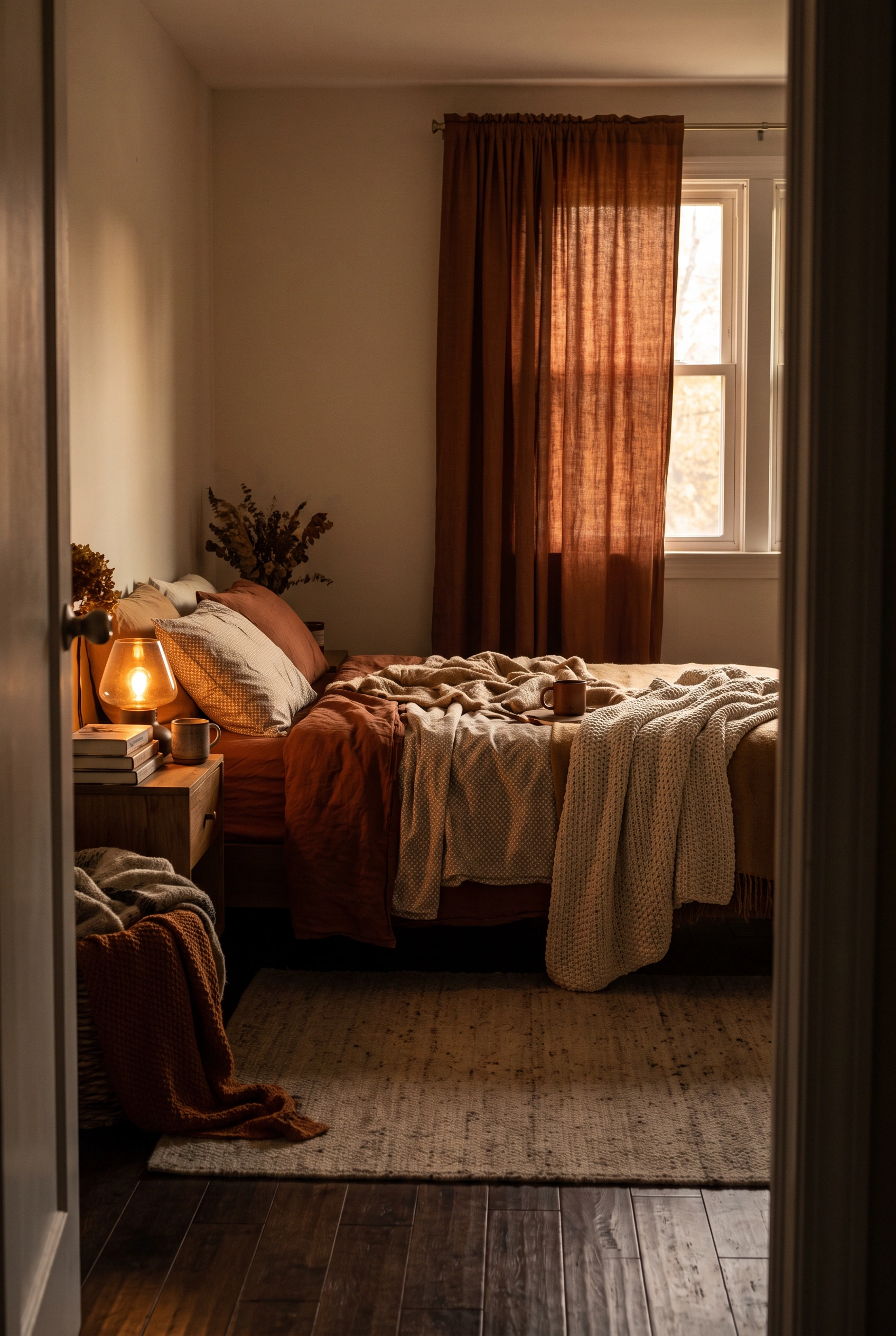
There is a specific evening in early autumn when you walk into your bedroom and the light is wrong. Nothing has changed, but the room that felt airy and bright in July suddenly feels flat and a little cold. Summer rooms are designed to feel open. Fall rooms need to feel held.
The instinct at this point is usually to buy pumpkins. But the things that actually change how a bedroom feels in October are not decorative objects at all — they are the four layers you barely notice: color depth, light temperature, texture underfoot, and how heavy the windows look.
These ten ideas work in that order, from the largest surface down to the smallest. You do not need all of them. Do the first four and the room will already feel like a different season.
Disclosure: This post may contain affiliate links. As an Amazon Associate I earn from qualifying purchases, at no extra cost to you.
The Quick Version
The order matters here more than in most decor lists, because each layer changes how the next one reads.
| # | The layer | What shifts it | Impact |
|---|---|---|---|
| 1 | Color, the largest surface | A deeper duvet cover | Highest |
| 2 | Texture on the bed | A chunky knit throw | High |
| 3 | Light temperature | Warm 2700K bulbs | Highest |
| 4 | Light height | A low bedside lamp | High |
| 5 | The lowest light layer | Warm fairy lights | Medium |
| 6 | Underfoot | A soft area rug | High |
| 7 | The windows | Heavier linen curtains | High |
| 8 | Scent | A woody candle | Medium |
| 9 | Reflected light | An arched mirror | Medium |
| 10 | One styled surface | Nothing — just editing | Medium |
Before You Start: 3 Rules for a Moody Room
- Moody is about contrast, not darkness. A room painted entirely in deep tones with no warm light reads as gloomy. What makes it cozy is the pool of warm light against the dark. Keep the light sources warm and low and let the corners fall into shadow.
- Change the biggest surface first. The duvet covers more visual area than every decor object combined. Changing it does more than ten small purchases.
- Three light sources beats one bright one. Overhead alone will undo everything else on this list. If you take only one idea from this post, take that one.
1. Start With the Bedding — It Is the Biggest Color Surface in the Room
What it shifts: the entire color temperature of the room, in one move.
Your bed takes up more visual space than anything else in the bedroom. A light summer duvet reflects a lot of light and keeps the room reading as bright and open. Swapping it for a deeper, warmer tone drops the whole room into autumn instantly — before you touch a single decorative object.
The Wake In Cloud Washed Cotton Duvet Cover Set in terracotta is a good version of this because of the fabric rather than just the color. Washed cotton has a slightly rumpled, linen-like texture that catches shadow, which is exactly what makes a bed look inviting rather than flat and hotel-like.
If terracotta feels like too much commitment, the same principle works with any deeper tone — olive, chocolate, deep clay, warm charcoal. What matters is that it is noticeably darker and warmer than what was on the bed in July. Keep the sheets underneath light for contrast at the fold.
→ Check the Washed Cotton Duvet Set on Amazon

2. Add Weight at the Foot of the Bed
What it shifts: texture, and the sense that the bed is layered rather than flat.
A made bed with a single flat surface always looks slightly unfinished. A throw folded across the lower third does two things at once: it breaks the plane of the duvet, and it introduces a second texture, which is what makes a room read as considered rather than plain.
The Bedsure Chunky Knit Throw works here because of the scale of the knit. Fine knits disappear against a duvet; a chunky cable throw creates actual shadow between the stitches, which is where the coziness comes from visually. In cream against a deeper duvet, the contrast does a lot of the work.
Fold it in thirds and lay it across the bed at an angle, not perfectly square. And leave one corner loose. A perfectly folded throw looks like a showroom; a slightly relaxed one looks like somewhere a person actually sleeps.
→ Check the Bedsure Chunky Knit Throw on Amazon

3. Change the Light Temperature Before You Change Anything Else
What it shifts: everything. This is the highest-impact idea on the list and it costs the least.
Most bedrooms have bulbs somewhere between 4000K and 5000K, which is a cool, slightly blue-white light. It is efficient and it is completely wrong for a bedroom in autumn. Cool light makes warm colors look muddy and makes a room feel like a waiting area at eight in the evening.
Swap to 2700K. These Amazon Basics A19 Dimmable Bulbs are soft white at 2700K, which is close to the color of old incandescent light, and they dim — which matters, because being able to drop to 30 percent in the evening is half of what makes a room feel moody rather than merely lit.
Check what fixtures you actually have before ordering, and confirm you have a compatible dimmer switch if you want the dimming to work. Non-dimmable bulbs on a dimmer flicker and buzz. If you have no dimmer, the 2700K swap alone is still worth doing.
→ Check the 2700K Dimmable Bulbs on Amazon
4. Bring a Light Source Down to Eye Level
What it shifts: where the light comes from, which is as important as its color.
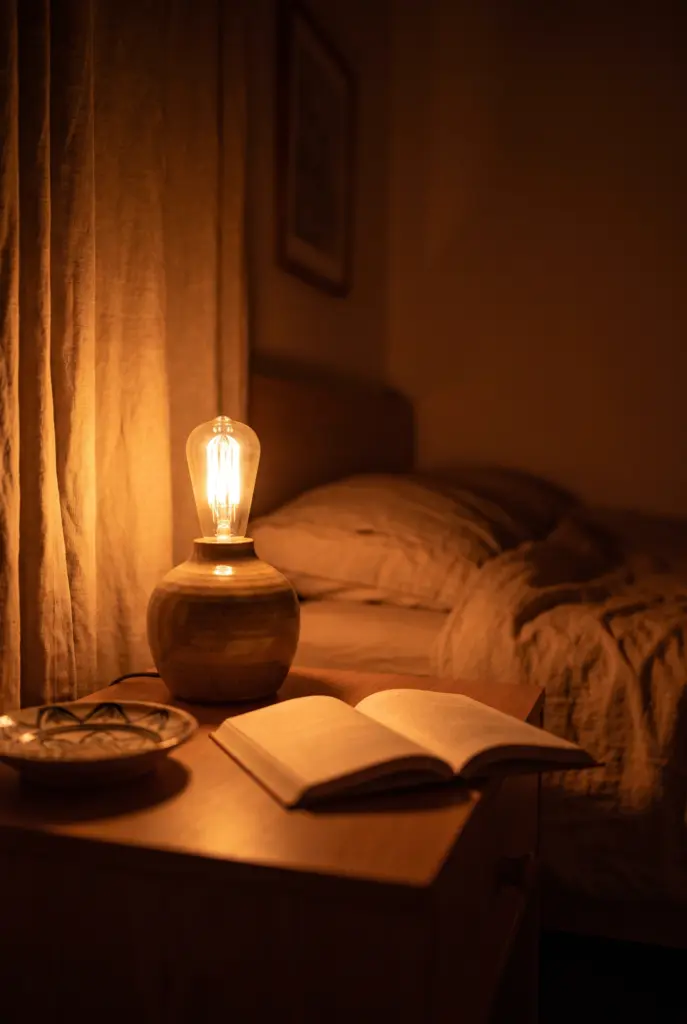
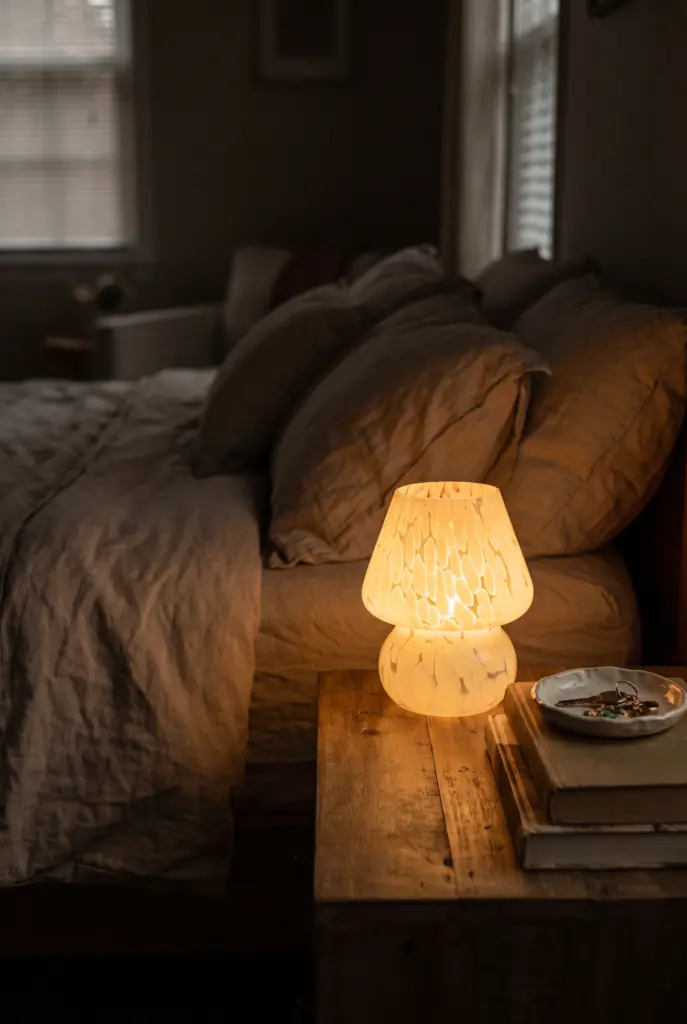
Overhead light comes from above and washes everything evenly, which is what makes rooms look flat. Light at bedside height creates a pool — bright at the nightstand, fading into shadow at the edges of the room. That gradient is the entire visual definition of cozy.
A small glass lamp like the ONEWISH Mushroom Lamp is well suited to this because the translucent shade glows rather than just directing light downward. It is stepless dimmable and includes a 2700K bulb, so it does the job of ideas three and four in a single object.
Position it on the nightstand and then, once it is on, turn the overhead light off entirely and look at the room. If it feels too dark, that is what the next idea is for — not a reason to turn the ceiling light back on.
→ Check the ONEWISH Mushroom Lamp on Amazon
5. Add the Lowest Light Layer
What it shifts: the corners of the room, which is where flatness usually hides.
With warm bulbs and a bedside lamp you have two light layers. The third is the one that fills in the edges — soft, dim, ambient, not really lighting anything so much as making the dark parts of the room glow faintly instead of going black.
Warm white fairy lights are the easiest version. These plug-in fairy lights with a remote and timer run 33 feet, dim in four steps, and shut off on a timer, which matters because the alternative is either leaving them on all night or getting out of bed to unplug them.
Two placement notes. Warm white only — cool white string lights will fight everything else you have done. And run them along one architectural line (behind the headboard, along a curtain rod, around a mirror) rather than draping them randomly. A single clean line reads as intentional; a swag across the ceiling reads as a dorm room in 2014.
→ Check the Warm Fairy Lights on Amazon

6. Put Something Soft Underfoot
What it shifts: how the room sounds, and the first thirty seconds of every morning.
This one is less visual than the others but people underestimate it badly. A hard floor in autumn does two things: it makes the room echo slightly, which reads as empty, and it makes getting out of bed physically unpleasant, which changes how you feel about the room without you noticing why.
A washable boho area rug in a 5×7 handles a standard bedroom. Washable matters here more than in a living room — a bedroom rug takes bare feet, spilled tea and, if you have pets, everything else, and being able to put it in a machine is the difference between keeping it two years and keeping it two months.
Placement rule: the rug should extend at least 18 to 24 inches past the sides of the bed, so your feet land on it when you get up. A rug that stops at the bed frame does nothing except cost money.
→ Check the Washable Area Rug on Amazon

7. Give the Windows Some Weight
What it shifts: how enclosed the room feels, and how well you sleep.
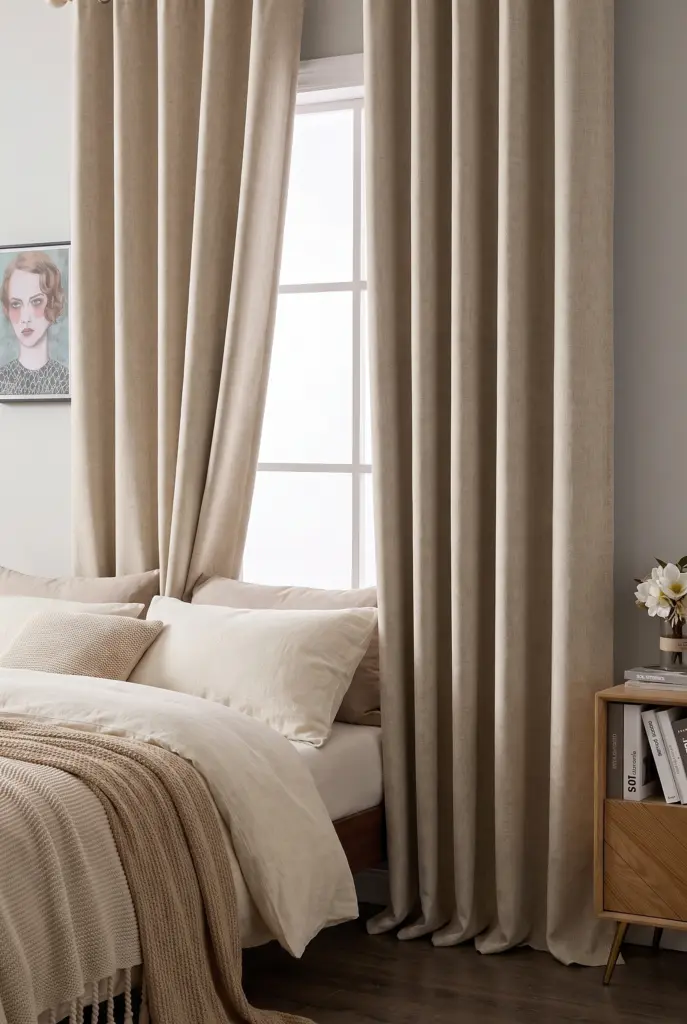
Thin summer curtains let a room feel connected to outside. In autumn you want the opposite — the visual sense that the room is a separate, contained space. Heavier fabric at the window does that immediately, and it darkens the room in a way that genuinely improves sleep as the mornings get lighter and then, later, as streetlights become more noticeable.
These MIULEE Linen Textured Blackout Curtains are a good middle ground: the linen texture keeps them looking soft rather than heavy and utilitarian, but they are fully room-darkening and thermally insulated, which is a small but real difference in an old apartment in November.
The single change that makes curtains look expensive: hang the rod higher and wider than the window frame — roughly four to six inches above the frame and eight to twelve inches wider on each side. The ceiling looks taller and the window looks bigger, and it costs nothing.
→ Check the Linen Blackout Curtains on Amazon
8. Add the Layer You Cannot See
What it shifts: the thing you notice first walking in, before you look at anything.
Scent is the fastest route to a seasonal feeling and the one most people skip because it feels frivolous. It is not. Walking into a room that smells like cedar and smoke in October changes your response to the room before your eyes have adjusted.
Go woody rather than sweet. The Calyan Wax Co. Cedar and Tobacco Candle is the right register for a moody room — cedarwood, oak, amber and vanilla rather than pumpkin spice, which is lovely in a kitchen and slightly overwhelming in a bedroom you sleep in. Soy wax, cotton wick, roughly 57 hours of burn.
Practical notes: trim the wick to about a quarter inch before every burn or you will get soot on the glass, let the first burn go long enough for the melt pool to reach the edges, and never leave it lit when you leave the room or fall asleep. If open flame is not workable where you live, a reed diffuser in the same scent family does most of the job.
→ Check the Cedar and Tobacco Candle on Amazon

9. Bounce the Warm Light Back Into the Room
What it shifts: the sense of depth, which is what stops a dark room from feeling small.
The risk with a moody room is that it closes in. A large mirror solves that without adding a single bright light: it doubles the perceived depth of the room and, more usefully in autumn, it takes whatever warm light you have and reflects it back rather than letting it get absorbed into dark walls and bedding.
An arched full-length mirror in black suits this palette better than gold, which can read a bit bright against deep autumnal tones. It leans, mounts, or free-stands, so you can try positions before committing.
Position it to reflect a light source or a window rather than a blank wall — that is the whole point of it. And if you are leaning rather than mounting, secure it to the wall anyway. A 64-inch mirror leaning against a wall is genuinely a safety issue in a bedroom, especially with pets or small children around.
→ Check the Arched Full-Length Mirror on Amazon

10. Style One Surface, Then Stop
What it shifts: whether the room reads as intentional or as accumulated. This one costs nothing.
At this point the temptation is to add — a pumpkin here, a garland there, three more candles, some dried stems. Resist most of it. A moody room is quiet, and quiet requires empty space to exist against.
Pick one surface, usually the nightstand, and style only that. Three objects at three different heights is the whole formula: something tall (the lamp), something low and flat (a stack of two books), something small and organic (a small dish, a single stem, the candle). Then leave every other surface almost bare.
The empty space is not a gap you have not filled yet. It is what makes the one styled surface read as deliberate. If you take one thing from this entire list, take that.
If you want to keep going after this, the same layering logic scales to the rest of the room — this take on dark cottagecore sits in the same palette, and if there is a desk squeezed into the corner, these small desk setup ideas cover getting it out of the way visually.
Fall Bedroom Questions People Actually Ask
What colors make a bedroom feel cozy in autumn? Warm deep tones with a light contrast layer: terracotta, rust, olive, chocolate, deep clay against cream, oatmeal or bone. What matters is depth plus warmth. Deep cool tones like slate or navy read as moody but not cozy without a lot of warm light to compensate.
How do I make a room moody without making it dark and depressing? Contrast. Keep the color depth but add three separate warm light sources at different heights. A dark room with one bright overhead light is gloomy; a dark room with warm pools of light at bedside height is cozy. The lighting does the work, not the color.
What is the cheapest change with the biggest impact? Swapping bulbs to 2700K. It costs less than almost anything else on this list and it changes how every other color in the room reads. Do it before you buy any decor.
Do I have to change everything at once? No, and it is better if you do not. Do the bedding and the bulbs first, live with the room for a week, then decide what still feels missing. Usually it is the rug or the curtains, and which one it is depends on your specific room.
How do I keep this from looking like Halloween decor? Skip anything explicitly seasonal — no pumpkins, no leaves, no orange objects. Work with texture and depth of color instead of motifs. The result stays right through January instead of looking wrong on November first.
Final Thoughts
A fall bedroom reset is not really about decorating. It is about adjusting four things — color depth, light temperature, texture, and enclosure — so the room does a different job than it did in summer.
Do the first four ideas on a Saturday afternoon and the difference that evening is genuinely surprising. Then leave it alone for a week before adding anything else. Rooms need a little time before they tell you what they are actually missing.
Product availability, colors, dimensions, and included components may change. Check the current Amazon listing before ordering, confirm dimmer compatibility before buying dimmable bulbs, and follow all candle safety guidance — never leave a lit candle unattended or burning while you sleep.
Small shifts, big vibes.