6 Things That Turn an Apartment Corner Into a Reading Nook You Actually Use
Most reading nooks fail for the same reason: they look right and nobody sits in them. The chair is in the corner, the blanket is folded over the arm, there is a small stack of books nearby — and the person who built it keeps ending up on the sofa with their phone.
The reason is almost always the light. A corner is the darkest part of any room, and reading in a dim corner is uncomfortable in a way you notice about ten minutes in, without consciously identifying why. So the nook gets abandoned and it is not clear what went wrong.
Get the light right and the rest follows. These six pieces are in the order that matters, and the first one is not the chair.
Disclosure: This post may contain affiliate links. As an Amazon Associate I earn from qualifying purchases, at no extra cost to you.
The Quick Version
| # | The piece | What it solves | Buy first? |
|---|---|---|---|
| 1 | Arc floor lamp | The corner is too dark to read in | Yes |
| 2 | Small armchair | Nowhere comfortable to sit for an hour | Yes |
| 3 | Knitted pouf | Legs have nowhere to go | Yes |
| 4 | Small round side table | Nowhere to put the mug | Yes |
| 5 | Floating shelves | Books live in another room | If you have wall |
| 6 | Chunky knit throw | It looks unfinished | Last |
Before You Start: Pick the Right Corner
- Not the darkest corner — the quietest one. You can add light. You cannot add quiet. Avoid corners next to a kitchen, a hallway, or a shared wall with a neighbour’s TV.
- Measure roughly 4 by 4 feet. That is genuinely all a nook needs: a chair, something for your feet, a small surface. If you have more, the extra is for the pouf and the shelves.
- Check where the nearest outlet is before you commit to the corner. A lamp cord running across a walkway is the fastest way to abandon a setup.
- Sit in the corner on the floor for five minutes before buying anything. You will notice the draft, the noise or the awkward sightline that no photograph would have shown you.
1. Fix the Light First
What it solves: the actual reason most reading nooks go unused.
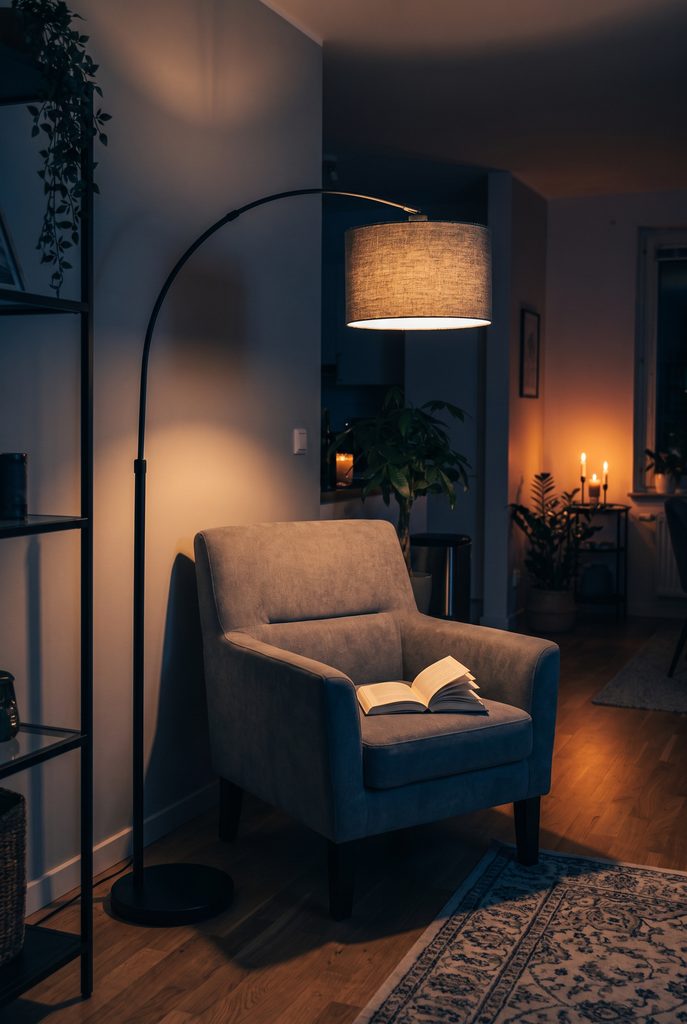
An overhead ceiling light is behind and above you, which puts your own shadow on the page. A small table lamp is usually too low and too dim. What a reading corner needs is light coming over your shoulder from above and to the side, which is exactly what an arc lamp is designed to do.
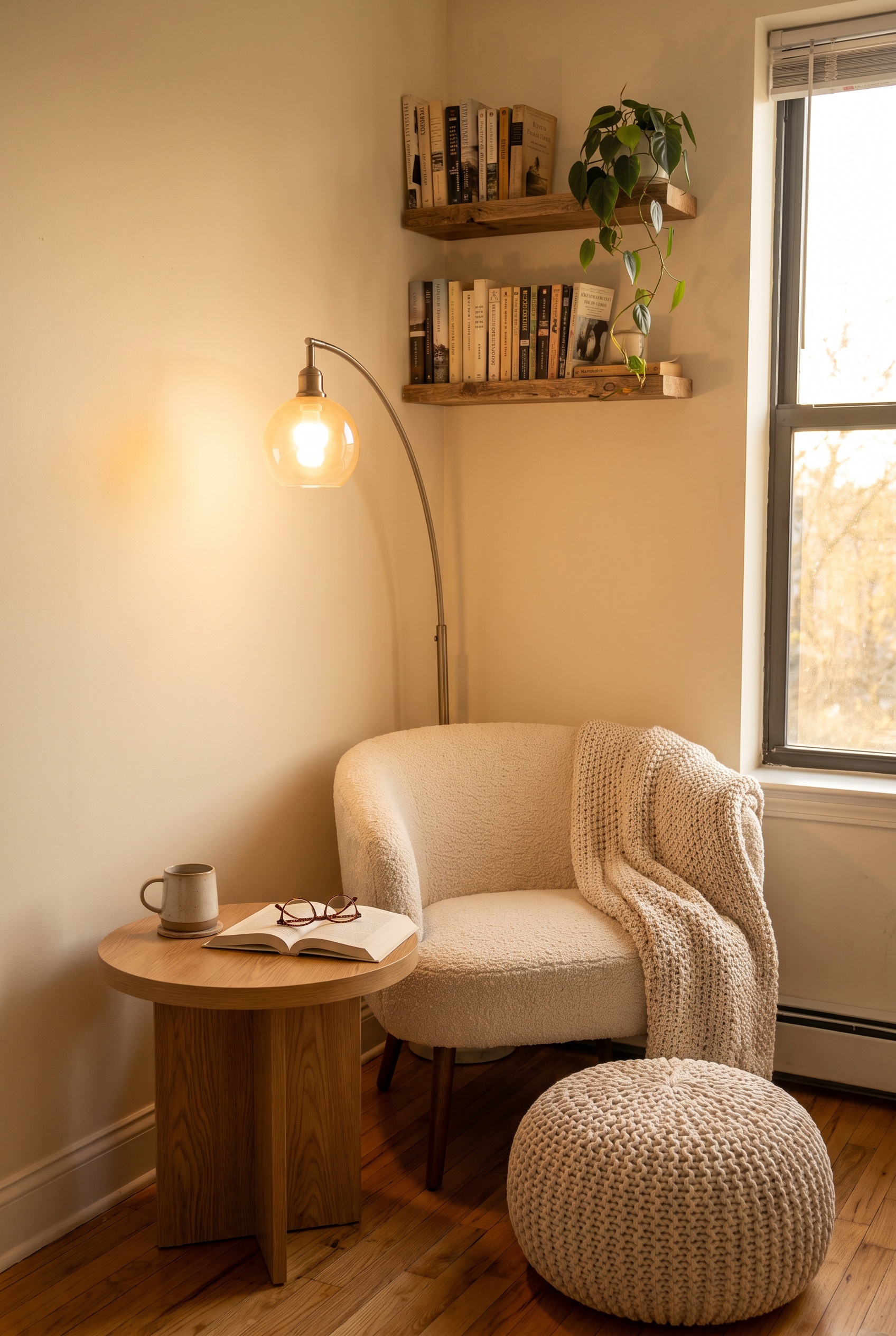
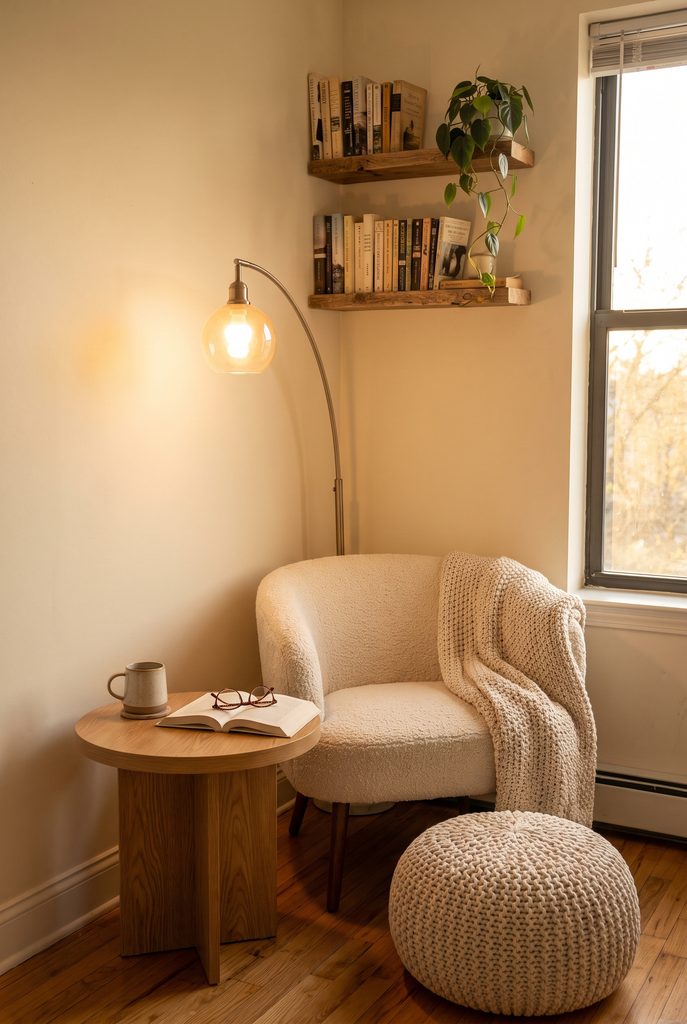
The arc floor lamp with a foot dimmer works well here because the arm reaches over the chair rather than standing beside it — no floor space lost, and the light lands on the page instead of the wall. The foot dimmer matters more than it sounds: you want it bright for reading and low for sitting, and you do not want to get up to change it.
Two things worth doing. Put a warm 2700K bulb in it rather than a cool white one, because cool light in a cozy corner undoes the entire point. And position the arm so the shade sits slightly behind and to the side of your shoulder, not directly overhead — directly overhead creates glare on a screen and shadow on a page.
→ Check the Arc Floor Lamp on Amazon
2. A Chair Small Enough to Fit, Deep Enough to Sink Into
What it solves: the fact that a dining chair in a corner is not a reading nook, it is a chair in a corner.
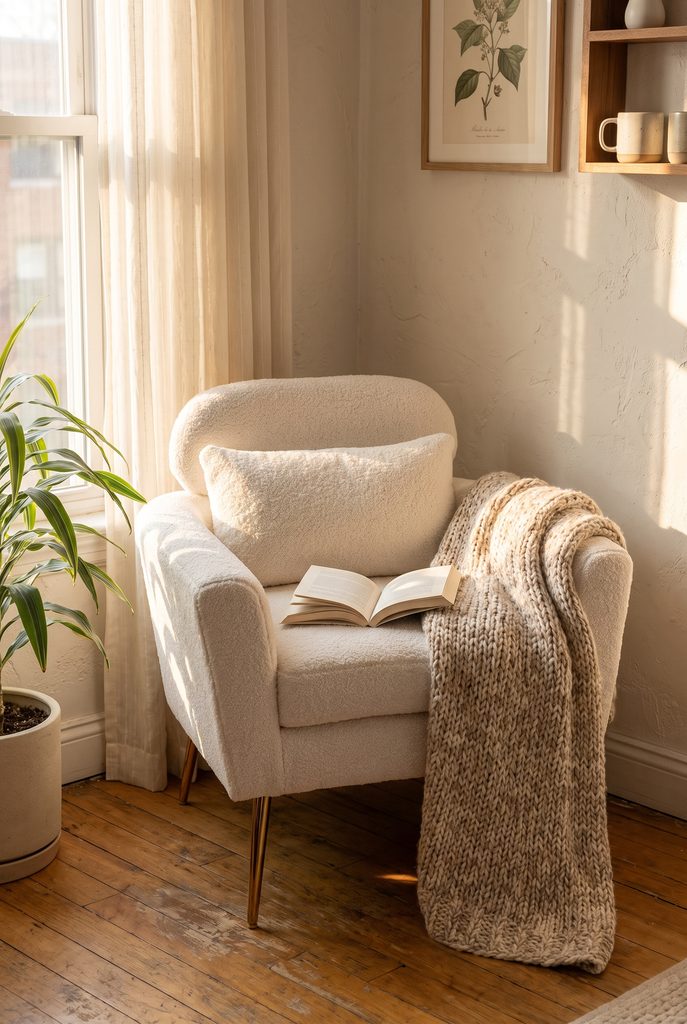
The tension in a small apartment is that comfortable chairs are large and small chairs are rarely comfortable. What resolves it is seat depth rather than overall width — a chair can be under 30 inches wide and still be something you disappear into, if the seat is deep enough to tuck your legs up.
This 29.5-inch boucle accent chair is around the right scale for a corner. Boucle is a good pick for a nook specifically because the texture reads as soft from across the room, which is half of what makes a corner look inviting rather than functional.
Measure the corner and then subtract: you want a few inches of breathing room on both sides, not a chair wedged wall to wall. A chair with visible space around it looks intentional. A chair jammed into a corner looks like storage.
→ Check the Boucle Accent Chair on Amazon
3. Somewhere for Your Legs
What it solves: the reason people last twenty minutes in a chair instead of two hours.
This is the most underrated piece in the whole setup. Sitting upright with your feet flat on the floor is a working posture — it is what you do at a desk. Reading for any length of time means putting your feet up, and without something to put them on you will migrate to the sofa within half an hour.
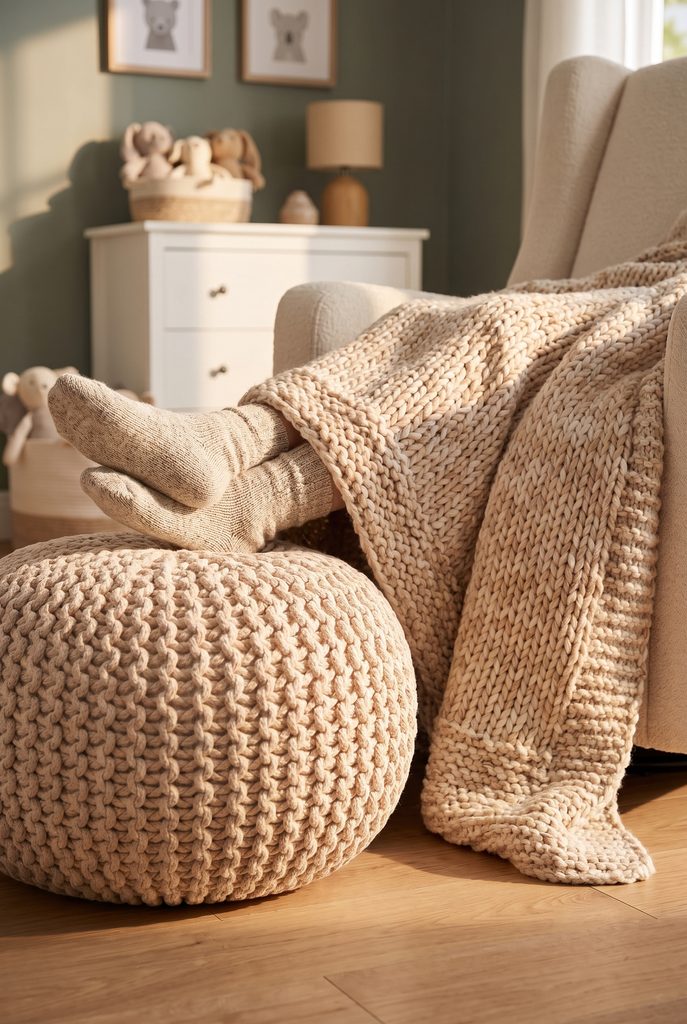
A round knitted pouf does this better than a rigid ottoman in a small space, because it is light enough to move with one hand, it doubles as extra seating when someone visits, and the knit texture matches the softness of the corner rather than looking like furniture.
Get one around 18 to 20 inches across and roughly the height of the chair seat or slightly lower. Too tall and it pushes your knees up uncomfortably; too small and your feet hang off the edges.
→ Check the Knitted Pouf Ottoman on Amazon
4. A Surface Within Arm’s Reach
What it solves: the mug on the floor, which gets knocked over exactly once and then you stop bringing drinks to the corner.
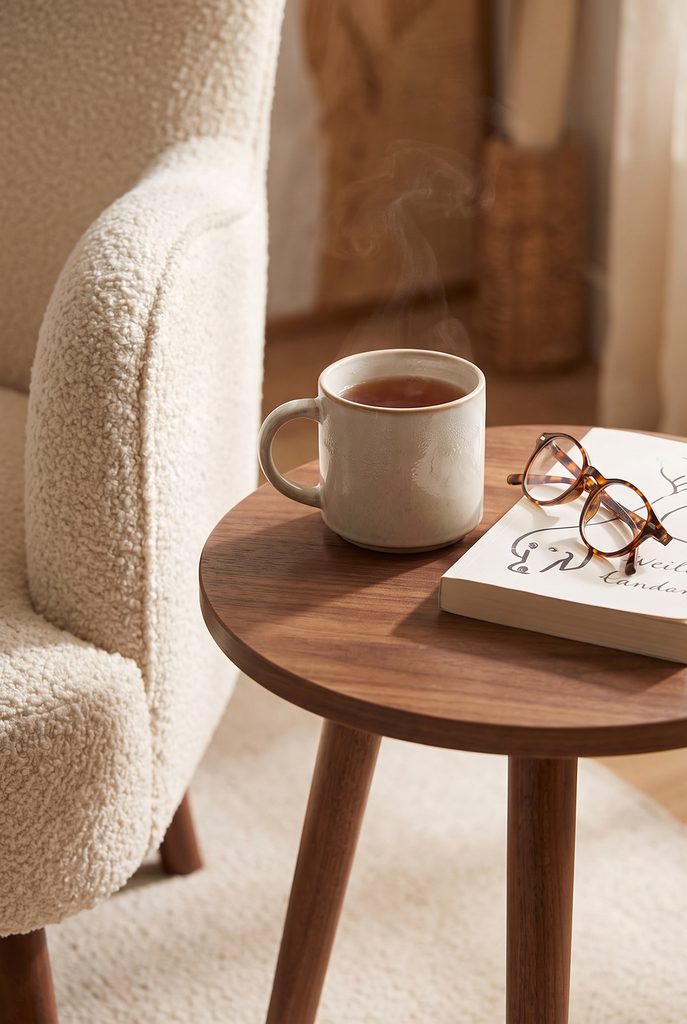
The requirement here is small and specific: somewhere to put a mug, a book face down, and your phone. It does not need drawers, it does not need storage, and in a corner this size anything large enough to be useful for storage is too large to fit.
A small round side table around 16 inches across is the right proportion. Round matters in a nook — the corner is already all straight lines (two walls, the chair, the shelf edges), and a circle breaks that up so the space does not read as boxy.
Height is the thing to check: roughly level with the chair arm, or an inch or two below. A table taller than the arm means reaching up and over for a mug, which is exactly the kind of small friction that quietly kills a habit.
→ Check the Round Side Table on Amazon
5. Put the Books in the Corner Too
What it solves: the gap between “I have a reading chair” and “I read there.”
If the books live in another room, the corner is a chair. Having something to reach for without getting up is what turns it into a place you end up rather than a place you plan to go.
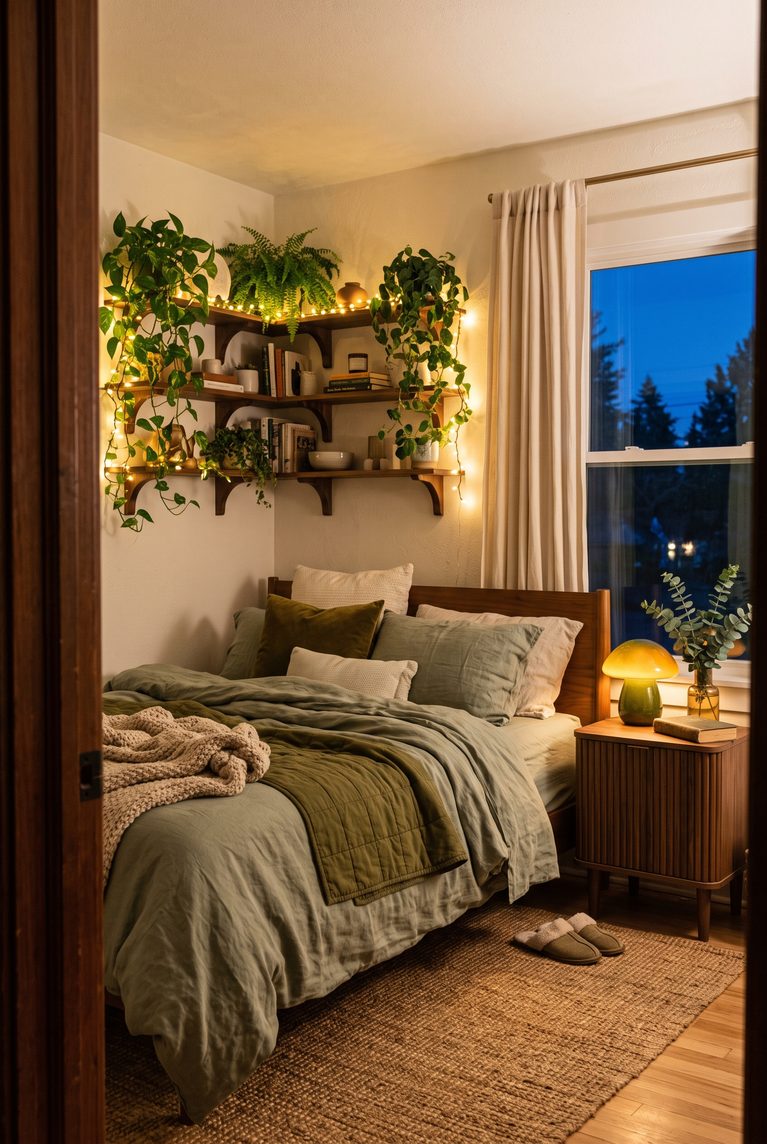
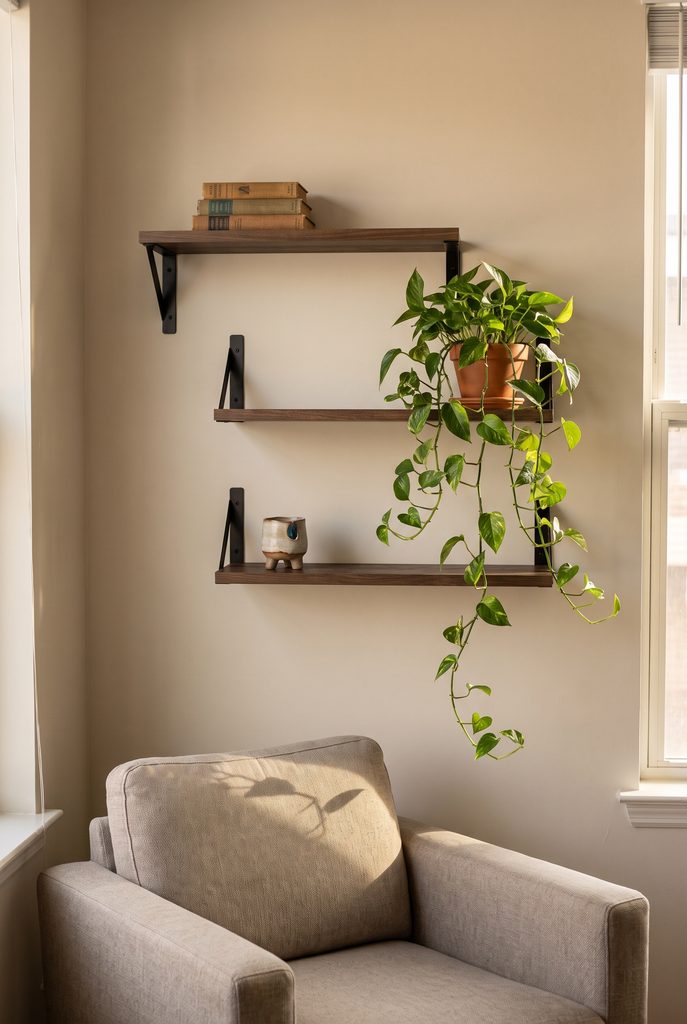
A set of three floating shelves mounted on the wall above and beside the chair costs no floor space, which matters when you have four feet to work with. Solid paulownia with metal brackets, and the short 17-inch length is the right scale for a corner — long shelves make a small nook look like a study.
Mount them staggered rather than evenly stacked, and do not fill them completely. Books plus one plant plus one small object per shelf, with visible empty space. A fully packed shelf reads as storage; a half-empty one reads as a corner someone actually uses.
Check what your wall is made of before you buy: plasterboard needs the right anchors, and a shelf of books is heavier than people expect. If drilling is not an option in your rental, a narrow leaning ladder shelf does the same job without hardware.
→ Check the Floating Shelves on Amazon
6. The Last Layer
What it solves: the corner looking almost finished.
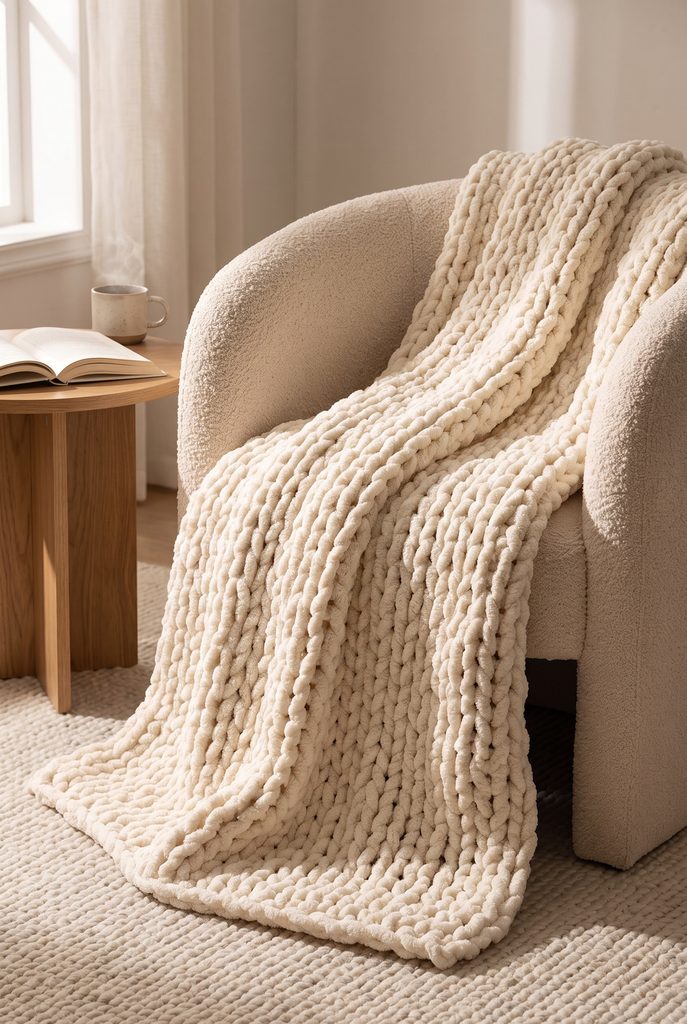
A throw is the piece that makes a reading nook look like a reading nook in a photograph, and it is also genuinely functional — sitting still for an hour makes you cooler than moving around does, which is why people reach for a blanket in a chair and not on their feet.
The chunky knit throw works because of the scale of the knit. A thin decorative throw disappears against the chair; a chunky one creates shadow between the stitches, and that shadow is what reads as warmth from across the room.
Drape it over one arm rather than folding it neatly across the back. A perfectly folded throw looks staged; one falling loosely over an arm looks like somewhere someone was sitting twenty minutes ago, which is the actual goal.
If the person using this corner is cold year-round rather than just in a chair, there are warmer options worth considering — a heated throw does the same job with a plug.
→ Check the Chunky Knit Throw on Amazon
The Order to Build It In
- Sit in the corner first. Five minutes on the floor tells you about the draft, the noise and the sightline.
- Lamp and bulb before anything else. If the light is wrong, nothing else will fix it, and this is the cheapest piece to get right.
- Chair, then pouf, measuring the pouf against the chair’s seat height rather than buying both blind.
- Table last of the furniture, once you know where the chair actually sits and which side your arm reaches from.
- Shelves when you know where your head lands in the chair, so you are not mounting them into your own eyeline.
- Use it for a week before adding anything decorative. Most corners need less than people think.
If the corner is in a bedroom rather than a living room, the same warm-light logic runs through the whole room — and if the corner also has to double as a workspace, these small desk ideas share the same wall-first approach.
Reading Nook Questions People Actually Ask
How much space do you need for a reading nook? About 4 by 4 feet is enough for a chair, a pouf and a small table. Anything smaller works if you drop the pouf and use a floor cushion instead.
What kind of lighting is best for reading? Warm light (around 2700K) at around 400 to 800 lumens, positioned above and slightly behind your shoulder. Overhead ceiling light alone puts your shadow on the page, which is the most common reason a corner feels wrong to read in.
Can you make a reading nook without a chair? Yes — a floor cushion, a large pouf and a few pillows against a wall works well and takes up less space. The lamp and the side table still matter just as much.
What if I can’t drill into the walls? Skip the floating shelves and use a narrow leaning shelf or a small basket of books beside the chair. Everything else here is freestanding.
How do I stop it becoming a place I dump laundry? Keep the chair clear as a rule from day one, and put something on it that has to be moved to sit down — a cushion, or the throw. Corners that accumulate laundry are usually corners with nothing in them.
Final Thoughts
A reading nook is not really a decorating project. It is a small set of removed frictions: enough light to read comfortably, somewhere to put your feet, somewhere to put a mug, and something to reach for.
Get those four right and you will use it. Get the aesthetic right and skip the light, and you will have a very nice photograph of a corner nobody sits in.
Product availability, colors, dimensions, and included components may change. Check the current Amazon listing and measure your space before ordering. For wall-mounted shelves, confirm your wall type and use appropriate anchors — a loaded shelf is heavier than it looks.
Small shifts, big vibes.